
Quantitative AI HFT Research Platform
A 100% secure infrastructure for AI Agents to test thousands of trading-related ideas per day. Automating the entire pipeline—from hypothesis generation to backtest.

“when the love of taking risks turns into a lifestyle”
Algorithms
Below is a list of the core algorithms and methodologies powering the platform.
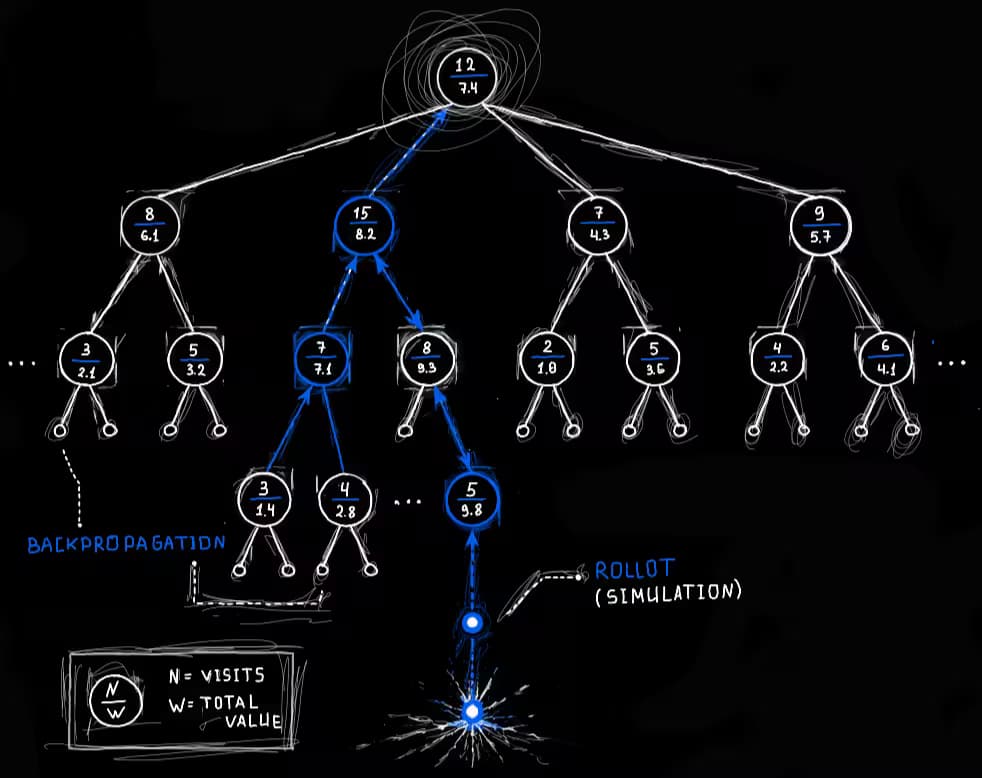
Adapted Monte Carlo Tree Search (A-MCTS)
Redesigned MCTS for optimal parameters search
Imagine you want to explore combinations of over 1000 assets, N targets, M date-ranges, close to 'infinity' number of hypotheses, and close to 'infinity' number of model settings, how would you approach it? Grid search? Random Search? Bayesian algorithms adaptation, Optuna?
MCTS is a complex algorithm that allows to make decisions in difficult situations where full search is impossible. The algorithm is optimized to discover the most perspective scenarios of HFT experiments without human intervention by incorporating HFT specific reward system, compressed memory of previous experiments, and AI agents.
Statistical Lab
Compare ideas easily

Statistical Lab is a technology that lets you perform AB tests of your ideas without spending time on experiment design. These are simple examples of questions you can easily answer in the Statistical Lab:
- →Will I maintain the experiment quality and lower the costs of those experiments by using LLM 'Y' instead of 'X'?
- →If I increase the context of a hypothesis generation agent, will it increase the number of SOTA experiments found?
- →Will changing LLM temperature from 0.2 to 0.6 increase my ROI?
Data Lab
The data processing engine is built for HFT scale. For example, Hyperliquid alone generates over 100 GB of data daily. In order to process such massive amounts of data during feature generation and training without RAM exhaustion, lazy mechanisms were developed.

Completely Safe Insfrastructure
AI Agents operate in strict isolation. They perform the full research cycle without ever accessing the code of trading algorithms, backtest engines, or sensitive data codebases and datasets. No AI model will ever be trained on your intellectual property.
Token Optimization
Tokens consumption is one of the most acute problems in agentic systems. The development of compression/search algorithms for coding agent and building no-agentic dependable algorithms to maximize the search space of hyperparameters while minimizing agentic triggers helped to prevent unnecessary token burn during heavy optimization phases.
Hybrid Capability
Total flexibility. Agents can either develop custom algorithmic code from scratch, optimize exisitng algorithms, or use the existing high-performance research infrastructure.
Statistical Precision
Advanced mathematical frameworks guide every decision. Manager Agent makes decisions about future actions in conjunction with Bayesian optimization and Thompson sampling to navigate the explore-exploit tradeoff.
Action Selection (Thompson Sampling)
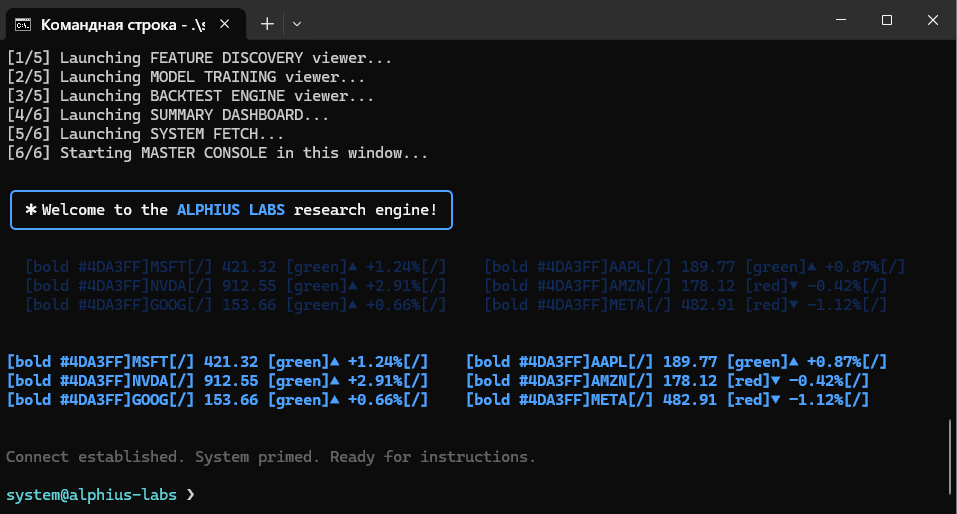
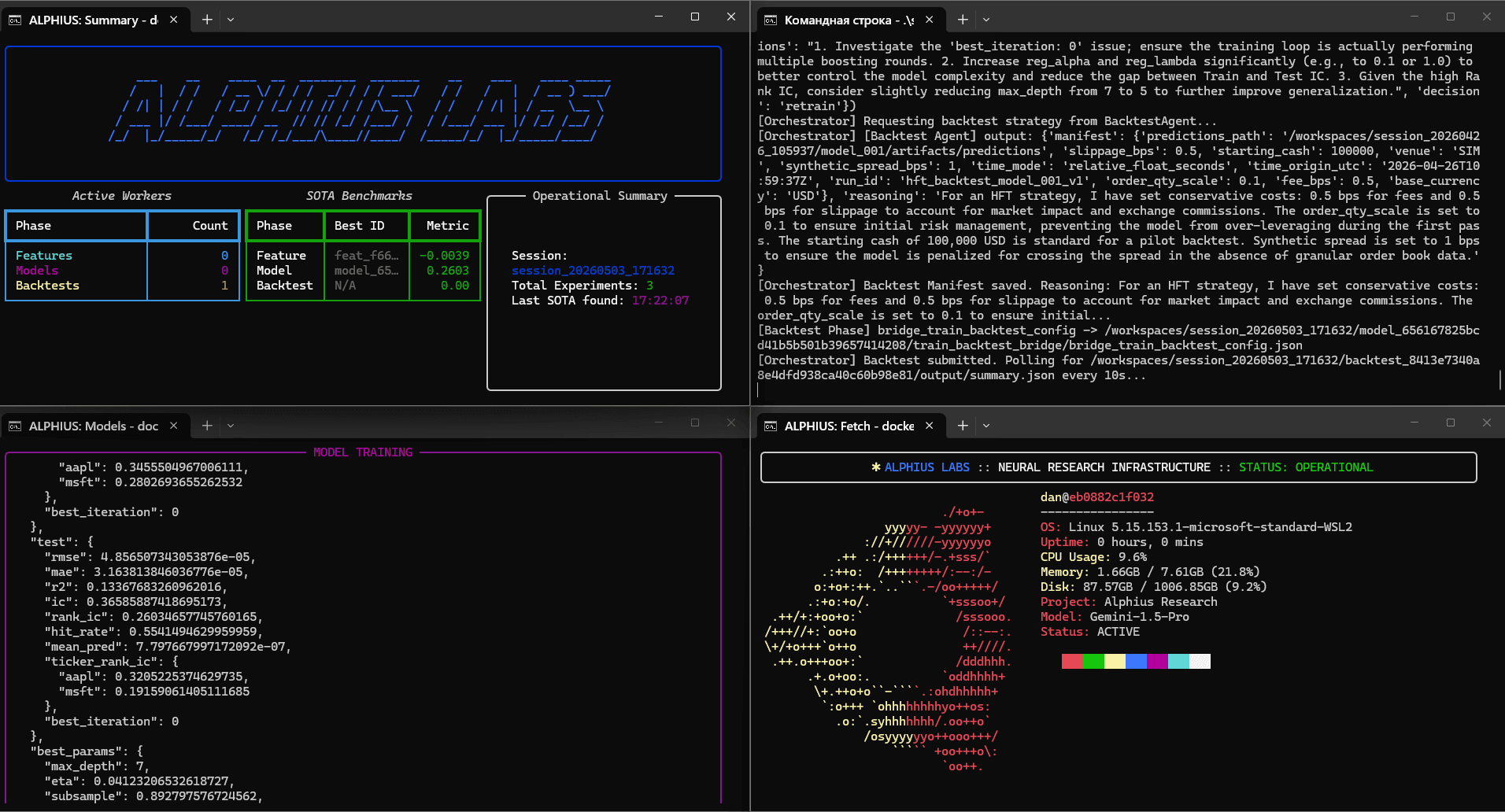
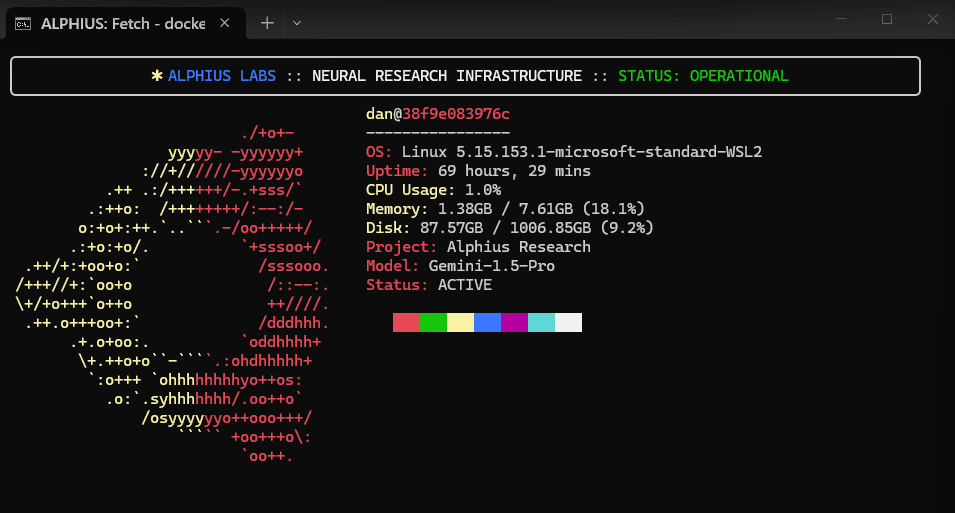
Real-time Monitoring
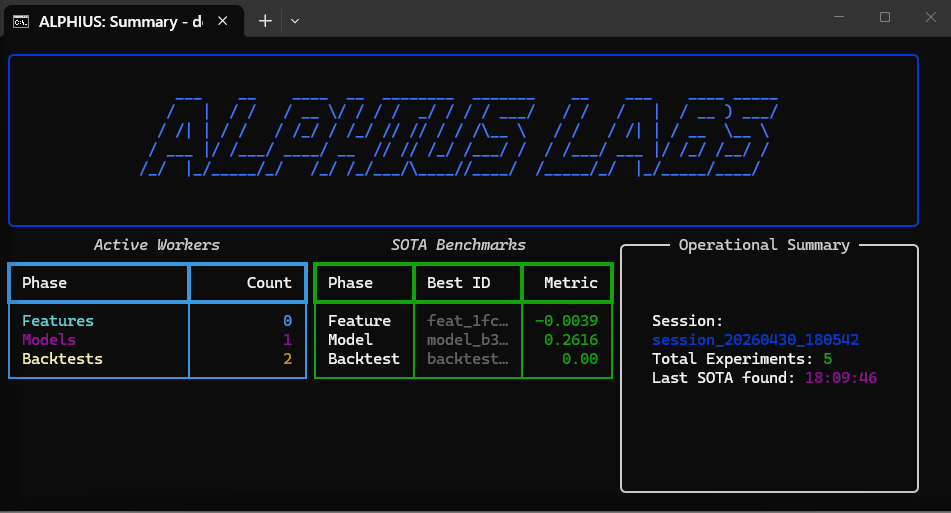
Watch your research ecosystem in action. Different terminals let you track metrics, experiment insights, hardware utilization, and more — all in real time.
Infrastructure-First AI Research
Alphius Labs builds the critical foundation first, then scales agent freedom responsibly to deliver SOTA results.
Earning Autonomy
The quality of AI research is defined by infrastructure. Giving agents full freedom too early does not usually break code - modern models can often handle implementation. The real failures happen deeper: flawed hypothesis structure, incorrect data processing, memory limits ignored, poor deployment pipelines for HFT production, and model choices that do not match dataset reality.
The agents' autonomy must be earned through engineering solutions and discipline. It is important to solve the most critical infrastructure risks first, because that is what guarantees correctness, repeatability, and trust in outcomes. Once the foundation is reliable, it is possible to expand agent freedom in controlled stages - this is a bottom-up approach in action.
"The goal is to find the point where control and freedom are perfectly balanced. That equilibrium produces the best possible outcomes in any field of research, not just HFT."
Performance vs. Freedom
Technologies





“future is discovered, not predicted”
Contact